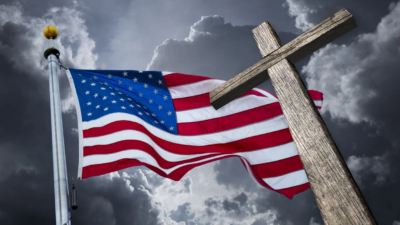
Recent reports unveil a disturbing alliance between high-level government officials and a Christian nationalist movement led by Pastor Douglas Wilson. Notably, Secretary of Defense Pete Hegseth’s attendance at Christ Church Washington D.C., a church affiliated with Wilson, signals a troubling shift in the religious-political landscape of the United States. Wilson’s doctrines and ambitions threaten the foundational principles of democracy, especially the separation of church and state, and pose serious risks to the rights and freedoms of all citizens.
Wilson’s vision for a theocratic America is undeniably radical. His advocacy for turning the U.S. into a Christian-led theocracy echoes historical visions of religious domination, contradicting the constitutional guarantee of religious freedom and the secular nature of government. Wilson’s expressed desire for the presence of his church’s influence “to benefit from the many strategic opportunities with evangelicals in and around the Trump administration” demonstrates a calculated effort to embed religious ideology within political power structures.
More alarmingly, Wilson’s views on gender roles, which include advocating for women to submit to their husbands and opposing women’s suffrage—a position he arguably promotes within his movement—are rooted in patriarchal, exclusionary, and authoritarian ideals. These beliefs undermine gender equality and reinforce a hierarchy that diminishes women’s agency, violating core human rights and risking systemic discrimination under the guise of religious doctrine.
Wilson’s influence extends into policy and legal systems. His stance that the 19th Amendment (giving women the right to vote) should be repealed, and his opposition to gay marriage, are direct assaults on the principles of equality and non-discrimination. Such positions, if embedded into policy, threaten to roll back advances in civil rights and entrench segregationist ideologies under religious pretexts.
The implications for American democracy are profound. Christian nationalism, as exemplified by Wilson’s teachings and Wilson-supported institutions, undermines the pluralism that is essential to a resilient democracy. When religious ideology becomes intertwined with state functions and policy-making, it can marginalize minority groups, erode democratic norms, and establish a hierarchy where religious authority supersedes constitutional principles.

The involvement of figures like Hegseth, who publicly displays religious symbols associated with extremist and nationalist rhetoric—such as the tattoo “Deus Vult” (“God Wills It”)—raises additional concerns. Historically, “Deus Vult” was a rallying cry during the Crusades, which often involved violent and oppressive expansionism justified through religious fervor. Its modern usage in this context signals a potential flirtation with similar exclusionary and militant ideologies.
Furthermore, Hegseth’s attendance at Wilson-affiliated churches and his praise for Wilson’s teachings blur the lines between religious faith and political allegiance, endangering the secular foundation of American governance. When faith-based identities influence defense and security policies, it risks politicizing institutions meant to serve all Americans regardless of religious belief.
The broader danger is this: Christian nationalism does not merely threaten individual rights but threatens the very democratic fabric—its pluralistic, inclusive, and democratic principles. As religious forces seek to gain political influence, history warns us of the dangers of theocracy, authoritarianism, and suppression of dissent. Democracy relies on the separation of powers, pluralism, and respect for individual rights—principles that are incompatible with the imposition of a singular religious and gender hierarchy.
Key threats include:
- Erosion of the Separation of Church and State: Christian Nationalists often advocate for religious beliefs to influence public policy, which undermines the constitutional principle of the separation of church and state. This can lead to laws and policies that privilege Christianity while marginalizing other faiths and secular perspectives.
- Restrictions on Reproductive Rights and Gender Equality: The emphasis on traditional gender roles and opposition to reproductive rights under Christian Nationalist influence threaten women’s autonomy and reproductive freedoms. Policies rooted in these beliefs may restrict access to abortion, contraception, and gender equality initiatives.
- Undermining Democratic Pluralism: By promoting a singular religious and cultural agenda, Christian Nationalism can foster intolerance toward dissenting voices, religious minorities, and secular citizens. This risks creating a society where disagreement with religiously motivated policies is marginalized or criminalized.
- Potential for Authoritarian Tendencies: The alignment of religious authority with political power can, in some cases, open the door to authoritarianism, where dissent is suppressed in service of a perceived divine order.
It is imperative that Americans remain vigilant. The alliance between government officials and radical religious ideologies like Wilson’s endangers our democratic future. Upholding the separation of church and state, defending gender equality, and protecting civil rights are essential in resisting the rise of Christian nationalism. Democracy thrives on diversity—political, cultural, and religious. Allowing a single religious ideology to dominate threatens to turn our nation into a theocratic state where freedoms are curtailed, and minorities face exclusion and persecution.
The fight against Christian nationalism is a fight to preserve the core democratic values that have defined America. We must scrutinize these alliances, question their implications, and reaffirm our commitment to a pluralistic and inclusive society. Democracy depends on it.
Share this:

Discover more from The Progressive Lens
Subscribe to get the latest posts sent to your email.