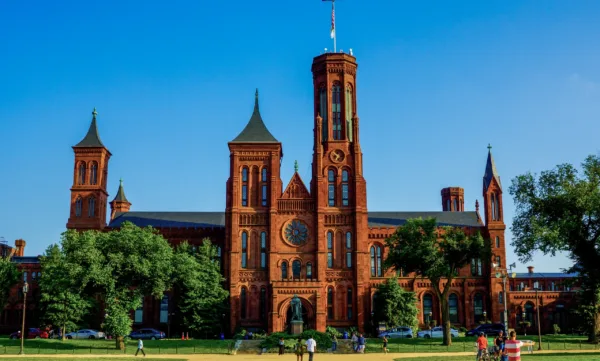
When a president orders a review of the nation’s museums to make sure they “celebrate American exceptionalism” and to excise “divisive or partisan narratives,” it is not oversight — it is an assault.
The White House’s directive, delivered in a letter to Smithsonian Secretary Lonnie Bunch III and signed by Lindsey Halligan, Vince Haley, and Russell Vought, demands an “alignment with the President’s directive to celebrate American exceptionalism, remove divisive or partisan narratives, and restore confidence in our shared cultural institutions.” The review — covering the National Museum of American History, the National Museum of Natural History, the National Museum of African American History and Culture, the National Museum of the American Indian, and several other flagship Smithsonian museums — comes with hard timelines (30, 75, 120 days) and a final report due in early 2026.
Read plainly, this is a cultural and political purge. The curatorial process, exhibition planning, use of collections, and narrative standards — the very mechanisms that let museums reckon with the messy, plural, and often painful truths of our past — have been placed under the thumb of an administration openly signaling it will sanitize and politicize history to fit a comfortable nationalist script.
This is not merely bureaucratic housekeeping; it is the weaponization of culture to manufacture consent. When a president demands that museums “celebrate” a sanitized, triumphant narrative and scrub away anything labeled “divisive,” he’s asking institutions charged with wrestling honestly with the past to become propaganda arms for a single, politically convenient myth. Museums don’t exist to flatter those in power — they exist to hold up mirrors to our history so the public can see who we were, who we are, and who we might become. Turning them into curated billboards for exceptionalism strips the public of the chance to learn, to grieve, and to reckon.
Look to history for the full measure of what’s at stake.
The Nazis infamously labeled modernist works “degenerate,” hauling art out of galleries, burning books, and replacing complex histories with a monocultural narrative that served a regime. Stalin’s Soviet Union blurred and erased faces from photographs and textbooks when political fortunes changed; history became malleable, a tool to glorify the state and obliterate dissenting stories. Mao’s Cultural Revolution smashed artifacts, closed museums, and silenced intellectuals in the name of ideological purity. Those campaigns didn’t merely rewrite events — they impoverished entire societies by removing the capacity for critical thought, empathy, and self-correction. The loss was not just cultural; it was moral and civic, paving the way for abuses that might otherwise have been contested.

The damage is predictable and preventable. A Smithsonian forced to toe an ideological line will marginalize the very voices that museums like the National Museum of African American History and Culture or the National Museum of the American Indian were created to preserve. Stories of slavery, colonization, resistance, and survival will be softened or sidelined until the public only sees an easy, heroic America stripped of its contradictions. Scholars and curators will be muzzled or pushed out; donors and visitors who value integrity will lose faith; and the next generation will inherit a smaller, less truthful archive — one curated to comfort the powerful rather than enlighten citizens.
We cannot pretend this is merely administrative oversight to be shrugged off. This is an attack on institutional autonomy and on the democratic principle that an informed public is essential to accountability. Museums are not neutral warehouses; they are civic spaces where contested meanings are debated. For a president to demand an expedient ideological alignment is to substitute political loyalty for scholarly rigor and civic trust.
So what should be done? First, congress should hold hearings and assert the Smithsonian’s independence, not its subordination to partisan diktat. Legal counsel and museum associations need to make clear that curatorial independence is professional and constitutional bedrock. Support should flow — financially and politically — to institutions and guardians of historical truth. Citizens should visit and patronize museums that resist this purge, donate to institutions that preserve marginalized histories, and raise awareness. After all, it’s OUR HISTORY.
Share this:

Discover more from The Progressive Lens
Subscribe to get the latest posts sent to your email.



One thought on “Cultural Purge: Trump Orders Review of Smithsonian and All Exhibits”
Comments are closed.